
Practical answers to the most frequently asked questions about choosing, assembling, and using SNAILER® roof tents.
Compatibility and assembly
On which cars can a SNAILER® roof tent be mounted?
SNAILER® roof tents are designed to be universal – they can be attached to almost any vehicle equipped with transverse roof racks (crossbars). It is not necessary to choose a tent according to a specific brand or car model. However, it is important that both the racks and the vehicle's roof itself have sufficient load capacity. Check the vehicle's registration certificate for the maximum permitted roof load; the dynamic load capacity must cover the weight of the tent and the racks themselves.
Can my car's roof carry a roof tent?
Yes – even though the tent's weight may be close to the limit of the dynamic load capacity, there's no need to worry. The specified limit (e.g., 75 kg) applies while driving, this is the dynamic load capacity of the roof. Static load capacity (when the car is stationary) is several times higher. It is common to assume that the vehicle's roof will carry the entire weight of the car in a rollover, so it can easily handle the tent with its occupants. Tents are mounted on crossbars, which distribute the weight to the load-bearing points – with correct assembly, there's no risk of denting or scratching the roof. Just ensure even weight distribution and follow the recommended assembly procedure.
What crossbars (roof racks) do I need for a roof tent?
We recommend using high-quality crossbars with side overhang (i.e., those that protrude on the sides beyond the rack feet). Their load capacity should be at least at the level of the tent's weight. Crossbars with overhang have several advantages:
Higher load capacity and stiffness: They usually carry a larger load because they have better weight distribution on the foot - the pressure acts perpendicular to the foot.
More convenient assembly: They create more space between the roof and the tent, making handling and fastening of the tent easier. (In some cases, crossbars without overhang may even be too short to fasten the tent.)
If you want to avoid complications, choose racks with overhang instead.

Comparison of crossbar types. On the left is a crossbar with overhang (green check mark) – we recommend this type for tent assembly. On the right is a rack without overhang (red cross mark), which may have lower load capacity and make assembly difficult.
Are crossbars included in the package? How do I get them?
No, transverse racks (crossbars) must be purchased separately. If you don't have them yet, we can also provide suitable racks ourselves – we cooperate with brands like Thule, Yakima, and Envio. Crossbars are chosen according to the type of car (or in some cases, universal models exist). If interested in crossbars, please contact us and state the exact model and year of manufacture of your car – we'll be happy to advise on selection.
Can I manage the tent assembly on my own?
The actual fastening of the tent to the crossbars is simple and can be handled by one person. However, to lift and place the tent on the roof, at least two people are needed – the tent weighs 67–75 kg depending on the model. Ideally, invite more people, especially if you have a taller car, to make lifting safe. After placing the tent on the crossbars, one person can correctly center and screw the tent using the included mounts.
What should be the distance between the crossbars when mounting the tent?
The crossbars should be spaced approximately as follows according to the roof tent model:
Alduo 100–120 cm
Abis 80–100 cm
Abis MAX 90–120 cm
These values are indicative – exact spacings can be adjusted according to the roof length and mounting possibilities of the specific vehicle. (It is not always technically possible to set racks exactly in this range.)
Especially with the Alduo model, be careful not to have the tent extended too far forward with a large front overhang. At high speeds on the highway, this could lead to a slight shaking of the tent, which is transmitted to the bodywork and reduces travel comfort. This case can occur, for example, with pick-ups if the tent is mounted over the cabin and protrudes significantly over the windshield.
In the case of vehicles with raised longitudinal rails (so-called roof rails, which are separated from the roof by a gap), we recommend placing the crossbars as close as possible to the feet – the points where the rails are attached to the roof. Not in the middle of the rail span, where the leverage and load on the rail would be greatest. (See the image below for an illustration of correct fastening.)
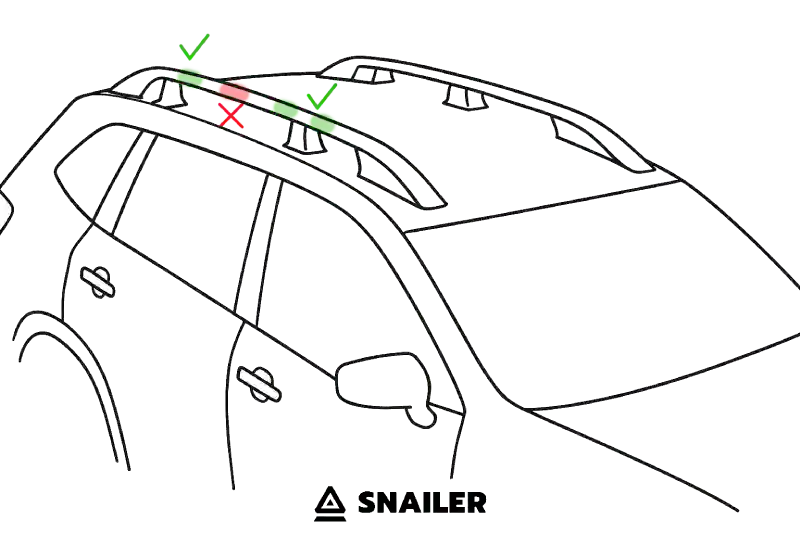
Correct placement of crossbars on raised longitudinal rails. The crossbars should be moved as close as possible to the points where the rails are attached to the roof (green check marks in the image), not in the middle of the rail span (red cross mark).
If your vehicle doesn't have roof rails and you consider their additional assembly (if it's possible for your model), definitely go for original parts from the manufacturer. Cheaper alternatives don't have enough stiffness and are not suitable for a roof tent.
Use and comfort
Do I need to buy anything extra to sleep in the roof tent?
Everything needed for a comfortable sleep is included in the tent package. Each SNAILER roof tent includes a thick foam mattress, a telescopic aluminum ladder, and assembly material. The equipment also includes an integrated anti-condensation mat under the mattress (against moisture). After mounting the new tent from us, you can spend the night right away – just unfold the tent on the crossbars and you can settle in for sleep. (Of course, don't forget to take pillows or sleeping bags and blankets according to the weather.)
Which SNAILER® roof tent model should I choose?
We currently offer three roof tent models – Alduo, Abis, and Abis MAX. All are reliable and durable, but differ in size and construction. The choice depends mainly on the number of people, desired comfort, and type of travel:
Alduo: Roof tent for 1–2 people. It features extra fast unfolding and folding (in a matter of seconds thanks to gas struts) and a durable all-aluminum construction. When folded it is very low (only ~20 cm high), so it has minimal impact on aerodynamics and car appearance. It's ideal for couples or solo travelers. Further accessories can be attached to the Alduo tent (awning, shower, light bar, etc.) and you can even mount additional crossbars to carry more cargo. Alduo also offers a beautiful view/outlook, as it has large openings on 3 sides.
Abis: Tent with more internal space – comfortably for 2 adults + 1 child. It has a hard shell (ABS plastic) and side opening. In the unfolded state it offers a larger bed than Alduo. Folding and unfolding takes a bit longer (about 1–2 minutes more than with Alduo, so still only a few minutes). When folded it is compact and with its elegant design fits even on smaller vehicles (hatchback, smaller SUV, or station wagon). The Abis model is a good choice if you want a family tent (2+1) and don't mind a few minutes longer folding compared to Alduo.
Abis MAX: The largest tent in the range – also suitable for 2 adults + 2 small children (or 3 adults). Constructively and by the folding mechanism it is identical to the Abis model, but has an extended footprint. In the unfolded state it provides the most internal space (longer bed and more width). When folded it is in size between the Alduo and Abis models – still relatively compact considering its space. We recommend Abis MAX for families with children or those who want maximum space and don't mind a few kilograms higher tent weight.
Is the mattress in the roof tent comfortable?
All SNAILER roof tents are equipped with a very comfortable and high-quality high-density foam mattress for comfortable sleep. Specifically:
– Alduo model has a 6.5 cm thick mattress with a double layer of foam (the bottom layer is firmer for support, the top softer for comfort). It is one solid mattress that covers the entire bed area 120×200 cm.
– Abis and Abis MAX models contain an approximately 5 cm thick mattress from one foam part (firmer foam). Due to tent folding, this mattress is composed of two parts connected by a cover, so that it doesn't bend when closing. In the unfolded state, however, it forms a uniform surface – the joint is almost unnoticeable and doesn't feel uncomfortable when lying down.
All our mattresses have a removable cover with a zipper, so they can be washed if needed. For even better comfort and hygiene, an anti-condensation mat is inserted under each mattress, which improves air flow under the mattress.
Can I leave pillows and a sleeping bag in the folded roof tent?
In the Alduo model, you can easily leave the ladder in the tent when folded – some pillows or blankets/sleeping bags will fit around it. We recommend distributing them evenly around the ladder so the tent closes easily.
In the more spacious Abis/Abis MAX models, not much space is left on the mattress, so we recommend leaving only a thin blanket or sheet inside, spread over the entire surface. Other items (e.g., pillows) can be stored when folding into the space next to the ladder – i.e., after folding the floor, just before closing the top cover of the tent. This way you can leave a few small things inside, but big sleeping bags or bulky duvets are better removed and transported separately.
How long does it take to unfold and fold the roof tent?
Unfolding and folding is a matter of just a few minutes and can be handled by a single person. The fastest is the Alduo model – opening takes about 30 seconds and securing the awning from inside up to 1 minute. Packing (including storing the ladder inside) can be done in about 2–3 minutes.
With the Abis and Abis MAX models, opening takes approximately 1 minute and tensioning the fabric 1–3 minutes extra. Packing the complete tent takes about 3–4 minutes.
These times are only indicative – with a little practice you can build and pack the tent very quickly, which is one of the great advantages of roof tents compared to conventional tents.
How fast can I drive with a mounted tent?
We recommend following a maximum speed up to 130 km/h. This corresponds to the highway limit in most countries and at the same time minimizes any aerodynamic load on the tent. Short-term exceeding of this speed by a few km/h (e.g., during overtaking) will not harm the roof tent, but generally, driving with a heavier load on the roof should be more cautious. At higher speeds, noise and air resistance also increase. For safety and tent lifespan, we therefore do not recommend driving long-term at higher speeds than the stated maximum.
Can the tent be used in winter? Is it suitable for year-round use?
Of course, SNAILER roof tents are designed for year-round use and can withstand even more demanding conditions. In the cold season, however, one must account for certain specifics – especially the formation of condensation (moisture) inside the tent. To increase comfort in winter, we recommend using an external heater (for example, a diesel heater). Our tents are ready for it – each has an integrated port for the heater hose. The tent itself provides good basic insulation, but at lower temperatures it is suitable to supplement the equipment with warm sleeping bags. Using a heater and correct equipment, you can comfortably camp even in sub-zero temperatures.
How does the tent withstand strong wind and rain?
SNAILER roof tents are constructed to handle even bad weather. The tent fly is from durable tent fabric (420D Oxford polyester with rip-stop grid) with high water resistance exceeding 3000 mm water column. This means the tent is waterproof even in heavy rain – the material doesn't let water through and all seams are taped or double-stitched to prevent leaking. The solid shell (roof) on the Abis and Abis MAX models also reliably protects against rain. Regarding wind, each tent has a robust construction and anchoring elements for stability. A correctly anchored tent can withstand even a sharper gust of wind. We recommend orienting the tent shell (the narrower side for the Alduo model) against the wind. During a common storm or windy weather you don't have to worry – the tent will keep you dry and safe. In case of extreme storms, however, we recommend folding the tent for the night or hiding in a solid building, as these are already extraordinary conditions.
When does condensation (moisture) form inside the tent and how to prevent it?
Condensation of water vapor can appear in the tent during cold nights, especially if the internal air is warmer and more humid than the outside air. It's a natural physical phenomenon – moisture from the air condenses on the colder walls of the tent. Moisture is added to the air by the person breathing (during 24 hours one exhales approx. 0.5 liters of water). The tent itself doesn't leak, but in the morning you can find water droplets on the inside of the fabric – this is precisely the condensed moisture, especially when it's freezing outside or very cold.
How can condensation be prevented or eliminated? There are three options:
1. Use an external heater. The most effective and comfortable way is to temper the tent during the night with a diesel heater. Warm air also heats up the tent walls, shifts the dew point, and moisture will not condense on the walls. At the same time you will have a pleasant warmth in the tent, you will not have to sleep in extremely thick sleeping bags and you will not breathe cold air. (Our tents have an inlet for the heater hose for easy use of the heater directly in the interior.)
2. Ventilate sufficiently. When you don't have a heater available, it helps to leave ventilation openings or windows slightly open so that air circulates. This reduces internal humidity and less condensation forms. This procedure works especially in milder conditions or during summer nights when the outside air is not too cold. Beware however in winter: at temperatures around zero, opening windows would lead to significant cooling of the interior, which is not very desirable – ventilation is therefore suitable rather when it's not so cold.
In addition to these solutions, it always helps to ventilate and dry the tent after waking up when it warms up. If you find that moisture has accumulated inside the tent (on walls or under the mattress), wipe it off or leave the tent open for a while to dry before packing it. We supply our tents with an anti-condensation mat under the mattress – nevertheless, it still holds that the tent should be left to dry properly before long-term closed storage.
Is it possible to make the inside of the roof tent completely dark even during the day?
Yes, you can darken the inside of the tent even during the day. Each opening (entrance or window) in the tent is equipped with a double-layer system – besides the mesh, it also has an external waterproof zipper fly. When all windows are zipped from the inside with covers, the tent will be practically dark even on a sunny day. The material of the covers is opaque and doesn't let light through, which you will appreciate if you want to sleep longer in the morning or take a nap in the afternoon. (Applies to all Abis, Abis MAX, and Alduo models.)
Maintenance and storage
How long will my roof tent last?
A roof tent is an investment for many years – with proper care, a roof tent can last 10 or more years without problems. Our tents are made of solid and durable materials: aluminum construction and shell or durable ABS plastic (which doesn't corrode), cover fabrics from UV-resistant polyester with rip-stop finish against tearing, all zippers and seams are massive and durable. The lifespan itself depends mainly on the way of use and maintenance. If you take good care of the tent, it will last you a very long time. We recommend checking the tent after each major trip, having it cleaned and dried. It is important not to store the tent moist for a long time – always let it dry thoroughly before storage so that mold doesn't form. During normal use in the season it doesn't matter if the tent stays on the vehicle for some time (it's built even for rain, wind, or sun), however long-term exposure to UV radiation and weather conditions can eventually fatigue the materials. Ideally, store the tent in a covered place outside the season. Occasionally you can lubricate moving parts (hinges, screws, locks), use silicone spray on zippers, and check seals. This way the tent will reliably serve you many seasons and maintain a great look and functionality.
How can I clean the mattress and textile parts of the tent?
The mattress has a removable zipper cover that can be washed if needed. We recommend washing it at lower temperatures (up to 30 °C) and not drying it in the dryer to prevent it from shrinking or being damaged. The foam mattress itself doesn't require cleaning during normal use – if it got moist or dirty, let it dry freely when removed and clean with a soft brush or vacuum cleaner. Regarding the tent fabrics, smaller dirt (dust, mud) is best left to dry and then brushed or shaken out. For larger contamination you can rinse the fabric with water or gently wash with a sponge and lukewarm soapy water. Do not use aggressive cleaners or solvents that could damage the impregnation. Let everything dry completely before packing or storage.
What if I must pack the roof tent wet?
If the situation doesn't allow otherwise (e.g., leaving a camp during rain), you can of course temporarily pack the tent wet. Important however is to unfold it again as soon as possible and let it dry thoroughly. If you left a moist or wet tent closed for a long time (more than 1–2 days), you significantly increase the risk of mold and odor. Therefore, as soon as you have the chance, open the tent in air and sun, wipe off any condensation from inside and let all materials dry thoroughly. A good prevention is to pack the tent as shaken out as possible (shake off excess water before packing) and unpack it at home even after light rain – sometimes even seemingly dry fabrics can have moisture on the inner side. Proper care prevents mold formation and extends the tent's lifespan.
Can I leave the roof tent on the car all year round?
Yes, you can have the tent on the roof long-term, but it's good to follow a few principles. Occasionally open and ventilate the tent itself when on the car during nice weather – it helps dry the inside and keep it in good condition. If you are not actively using the roof tent, especially during transition periods (spring, autumn) and in winter, we recommend removing the mattress from it and storing it in a dry place. This prevents eventual wetting of the mattress (e.g., from condensation) and the formation of mustiness. Also realize that year-round exposure of the tent to weather conditions (sun, UV radiation, temperature fluctuations) can gradually cause color fading or small wear of rubber seals. Also expect slightly higher fuel consumption because the tent increases air resistance and vehicle weight. Therefore, it is best to pack the tent and store it off the season – you save fuel and unnecessary wear. But if you leave it on the car, nothing fundamental happens, the tents are built for rain or frost too. Just don't forget about the mentioned drying, ventilation, and checking the fastening, especially before driving.
How to store the tent off the season?
You can store the roof tent horizontally, or on the side vertically, in a dry place with a mild climate. You can place it on soft foam pads or on cardboard, ideally on several equally high supports so that it is evenly supported and doesn't stand directly on edges and get abraded. At the same time, make sure the tent cannot fall – leaning against a wall or attaching with straps to a stable point is suitable for safety. The Abis model has a painted top cover, which is more sensitive to scratching, so when storing vertically, rather wrap it in soft cloth or foam (even if it's stored in a box). Remove the mattress and store it in a dry place outside the tent. Always clean and dry the tent thoroughly before storage. Once in a while you can unfold and ventilate it so it doesn't get "musty". Proper storage will ensure that in spring the tent will be ready in 100% condition for further adventures.
Warranty and service
What warranty do SNAILER® roof tents have?
On all SNAILER® roof tents, we provide a standard 2-year warranty from the date of purchase. The warranty covers manufacturing defects, constructional and material flaws that manifest during normal use. It does not apply to normal wear, mechanical damage caused by incorrect use or negligent maintenance. In case of a claim for a manufacturing defect during the warranty period, we will eliminate the defect free of charge – depending on the nature of the problem, either by repair or replacement of defective parts. We handle claims promptly in accordance with valid laws and our business conditions. After the warranty expires, we of course continue to offer support and service for our customers.
Do you provide spare parts or out-of-warranty service?
Yes, for all our tents we keep necessary spare parts in stock. In case of damage or loss of a component (for example gas struts, covers, ladder, etc.), we can supply a new part or arrange repair. Just contact us and describe what part you need – we'll be happy to help. SNAILER roof tents are modular and repairable; most components can be replaced and the tent can thus serve for many years. Your satisfaction is our priority, therefore you can turn to us with any question regarding servicing the tent.